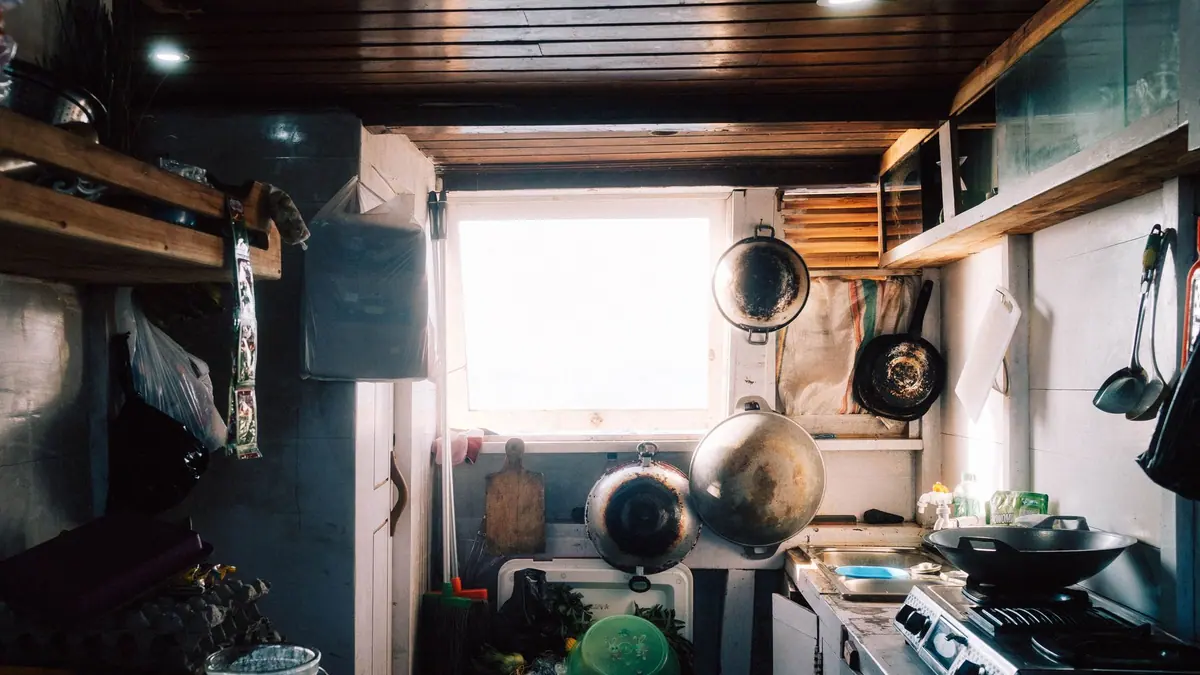
Most cookware advice is written for a kitchen that does not exist in a flat: one with a powerful extractor vented outside, room to store six pans, and a hob that can take two large pieces of cast iron at once. If your kitchen has a recirculating hood with a tired filter, no window, and one cupboard, that advice actively works against you.
The constraint changes the answer. Very high heat plus poor extraction equals a smoke alarm and a flat that smells of last night’s dinner in the morning. So the pans worth owning are the ones that produce good results at moderate heat, store compactly, and do not need a long preheat that fills the room before the food goes in.
Why heat is the real constraint
Searing works by getting a surface hot enough to brown quickly. The oil that makes that possible starts breaking down and smoking at a temperature that depends on the oil, and in a room that cannot clear that smoke, the practical ceiling is lower than the technically ideal one.
Cast iron and carbon steel are superb precisely because they hold enormous heat. In a well-ventilated kitchen that is their virtue. In a badly ventilated one it is the problem: they take several minutes to reach temperature, radiating into the room the whole time, and they hold that heat long after you would like them to stop.
The pans that suit a small kitchen are responsive rather than retentive. They heat quickly, they cool quickly when you turn the hob down, and they let you cook at a moderate temperature without losing control.
What to buy, in order
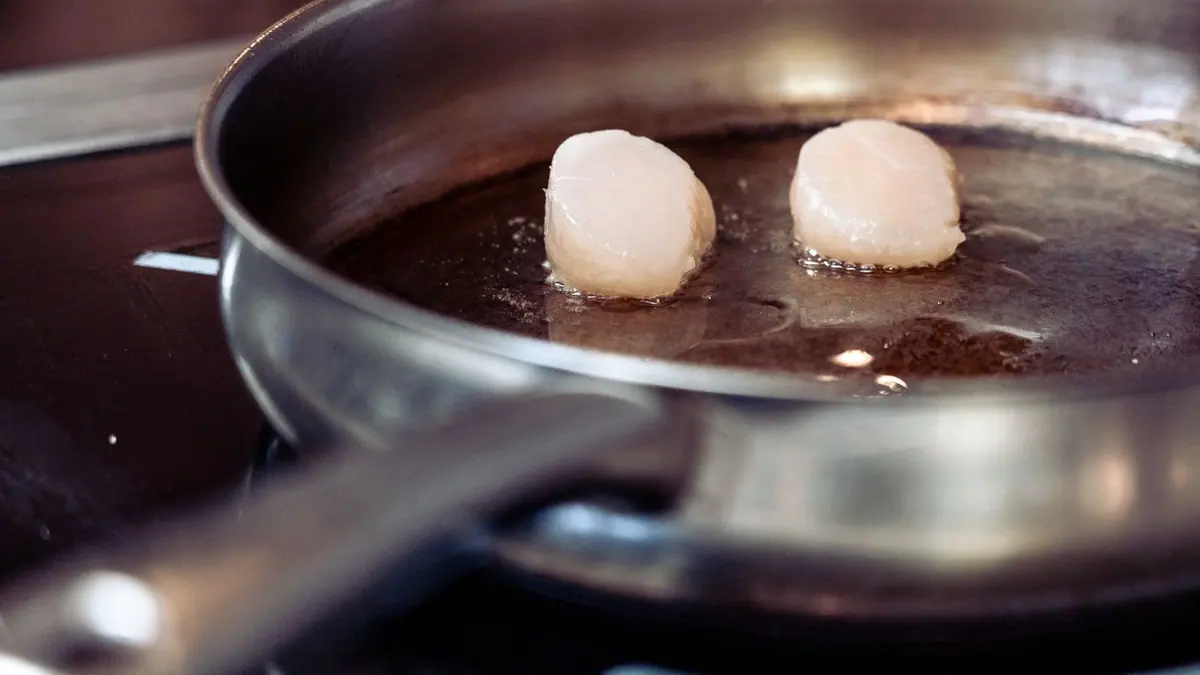
- A clad stainless sauté pan, around 24cm. The single most useful pan in a small kitchen. Responsive, oven-safe, and it browns well below smoking temperature.
- One good non-stick frying pan. For eggs and fish, where sticking ruins the result and low heat is correct anyway. Treat it as a consumable.
- A lidded saucepan that stacks. Check that the lid sits inside the pan above it rather than on top, which is the difference between two cupboard shelves and one.
- A wide, shallow casserole rather than a tall stockpot. More useful surface, easier to store, and it doubles as a roasting dish.
That is four pans, and for most small kitchens it is enough. The temptation is a matching set of ten, which is how cupboards fill with a milk pan nobody uses and a stockpot that lives on top of a wardrobe. The same restraint applies to appliances: a stand mixer is superb in the household that needs one and a large object in every other.
The 24cm sauté pan deserves the top slot because of how many jobs it absorbs. It browns meat, it holds enough liquid to finish a sauce in the same pan, it takes a lid, and it goes in the oven. In a kitchen where every item has to justify a shelf, a pan that replaces three is worth more than a pan that is marginally better at one thing. Size matters here too: 24cm fits two portions in a single layer and still sits comfortably beside a saucepan on a compact hob, which 28cm often does not.
The non-stick pan is the opposite case — a specialist you should expect to replace. Coatings degrade with heat and abrasion no matter how carefully you treat them, and the failure is gradual rather than sudden, so people go on using a pan long after it stopped being non-stick. Budget for replacing it every few years, keep it off high heat, and do not let it become the pan you reach for by default.
Materials, honestly compared
| Material | Good in a small kitchen? | Why |
|---|---|---|
| Clad stainless | Yes, the default | Responsive, durable, dishwasher tolerant, no coating to fail |
| Non-stick aluminium | Yes, for one pan | Low-heat cooking only; the coating is the lifespan |
| Cast iron | Rarely | Long preheat, heavy to store, holds heat you cannot vent |
| Carbon steel | Only if you already love it | Excellent but wants high heat and careful seasoning |
| Enamelled cast iron | One piece, maybe | Great for slow oven work; too heavy to be a daily pan |
Clad stainless is the recommendation for a simple reason: it is the only material on that list with no failure mode that ends the pan. Coatings wear out. Seasoning gets stripped. Stainless just gets scratched and carries on, which over a decade makes it far cheaper than the sticker price implies.
Storage is a specification
In a kitchen with one pan cupboard, how something stores is as important as how it cooks. Look for nesting shapes, lids that sit down inside the rim, and handles that do not stick out at an angle. Removable or short handles are worth considering; long ones make a stack impossible.
The same logic applies to the hob. Two large pans that cannot sit side by side means every meal is staged, which is slow and generates more heat and steam overall. Measure your hob and buy pans that fit it in pairs.
Weight belongs in the same conversation. A pan that lives in a low cupboard has to be lifted out at an awkward angle, and one that has to come down from a high shelf has to be lifted overhead. Either turns a heavy pan into a small daily deterrent, and a pan you avoid reaching for is not saving you anything however good it is on the hob.
Who this isn’t for
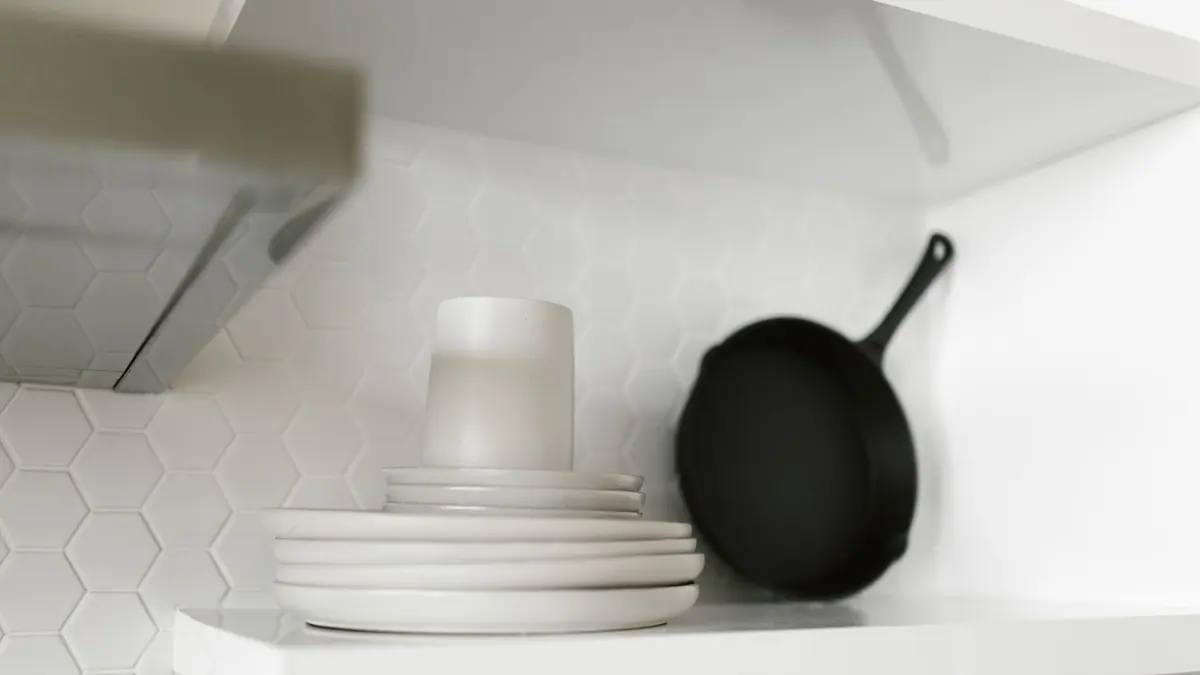
Ignore all of this if you have proper extraction vented outside. With a real hood, cast iron and carbon steel become the better answer and the whole calculation flips — you should buy for heat retention, not responsiveness.
Skip it too if your cooking is mostly boiling, steaming and oven work. None of the reasoning above applies to a pot of pasta, and you would be buying a solution to a problem you do not have. And if you cook for six regularly, a small kitchen setup will frustrate you regardless of materials; the constraint there is hob space, not pans.
What to know before you buy
- Measure the hob and the cupboard before choosing sizes. Fit is the first specification.
- Check the lid design. Lids that seat inside the rim save a whole shelf.
- Buy pans individually. Sets are priced around pieces you will not use.
- Treat non-stick as a consumable and do not overpay for it. Buy one, replace it when it fails.
- Prefer a wide shallow casserole to a tall stockpot unless you make stock.
- Clean the extractor filter. A clogged filter is the most common cause of a smoky kitchen, and the cheapest to fix.
Is expensive cookware worth it?
For clad stainless, often yes — the difference is in how evenly the base spreads heat, which is a manufacturing cost. For non-stick, no. The coating fails on a similar timescale regardless of price, so an expensive non-stick pan is an expensive consumable.
Do I need an induction-compatible set?
If there is any chance of moving to induction, buy pans that work on it now. It costs nothing extra in stainless or cast iron, and it removes a whole category of future regret. Check for a magnetic base rather than trusting the packaging.
How many pans do I actually need?
Four covers almost everything: a sauté pan, a non-stick frying pan, a saucepan and a casserole. Anything beyond that should be bought because a specific meal demanded it, which is the same principle we apply in five questions before any large purchase.
The short version is that a small, poorly ventilated kitchen is not a worse kitchen — it is a different one, with a lower practical heat ceiling and less storage. Buy responsive pans rather than heat-retentive ones, buy four rather than ten, and check that they stack. And if you are also weighing up counter appliances for the same space, our piece on air fryer capacity makes the same argument about measuring first.