Fine hair has a specific failure mode. It looks good for an hour, then gradually collapses, and by early afternoon it is flat against the scalp with no obvious explanation. The usual assumption is that this is simply what fine hair does. Often it is what a particular way of drying it does.
Heat is the culprit more often than product. Fine strands have less mass to absorb it, so they reach the point of over-drying quickly, and over-dried hair loses the slight spring that holds volume at the root. The dryer that suits fine hair is therefore not the most powerful one. It is the one that moves a lot of air at a temperature that does not cook it.
Airflow does the drying, heat does the damage
A hair dryer removes water in two ways: by warming it so it evaporates faster, and by moving air across the hair to carry the moisture away. Both work. Only one of them harms the hair.
This is why the useful specification is airflow rather than wattage. A dryer that pushes a large volume of air at moderate temperature dries fine hair about as quickly as a hotter one and leaves it in better condition. Wattage tells you how much electricity the appliance consumes, which correlates with heat far more reliably than it correlates with speed.
Unfortunately airflow is published far less often than wattage. Where a manufacturer does state it, treat it as the more informative number. Where they do not, a useful proxy is whether the dryer has a genuinely powerful cool setting: machines designed around airflow tend to have a cool shot that actually shifts hair, while heat-led machines have one that barely registers.
What to look for, in order
- A concentrator nozzle that stays on. Aiming the airflow along the hair rather than at it is most of the technique. A nozzle that falls off makes that impossible.
- Independent heat and speed controls. Combined settings force you to accept more heat to get more air, which is exactly backwards for fine hair.
- A cool shot that is genuinely cool and genuinely strong. This is what sets the shape once the hair is dry.
- Low weight. Drying with a round brush means holding the dryer up for several minutes; arm fatigue changes technique long before hair is dry.
- A removable filter. A clogged filter reduces airflow and raises temperature, which converts a good dryer into a bad one over months.
The filter point is worth dwelling on. Almost every complaint that a dryer has become hotter and slower over time is a blocked filter, and almost every dryer has one that people never clean because they do not know it is there. If nothing else in this piece is acted on, clean the filter.
Where the money goes
| Feature | Worth paying for? | Why |
|---|---|---|
| High airflow motor | Yes | Dries faster at lower temperature, which is the whole point |
| Low weight | Yes, for fine hair | Round-brush drying is an arms-up job; weight changes technique |
| Heat control that is measured, not stepped | Sometimes | Useful if you dry daily; unnecessary if you air dry most days |
| Ionic function | Marginal | Reduces static and can flatten very fine hair. Prefer one you can switch off |
| Attachment sets | Rarely | A concentrator and, for waves, a diffuser. The rest go unused |
| Quiet operation | Yes, in a shared home | The difference between drying at seven and waiting until eight |
Ionic technology deserves an honest note rather than either the enthusiasm or the dismissal it usually attracts. It reduces static and helps smooth the hair surface, which is welcome on thick or frizzy hair. On very fine hair the same smoothing effect can read as flatness. A dryer that lets you turn it off is more useful than one that insists.
Technique matters as much as the machine
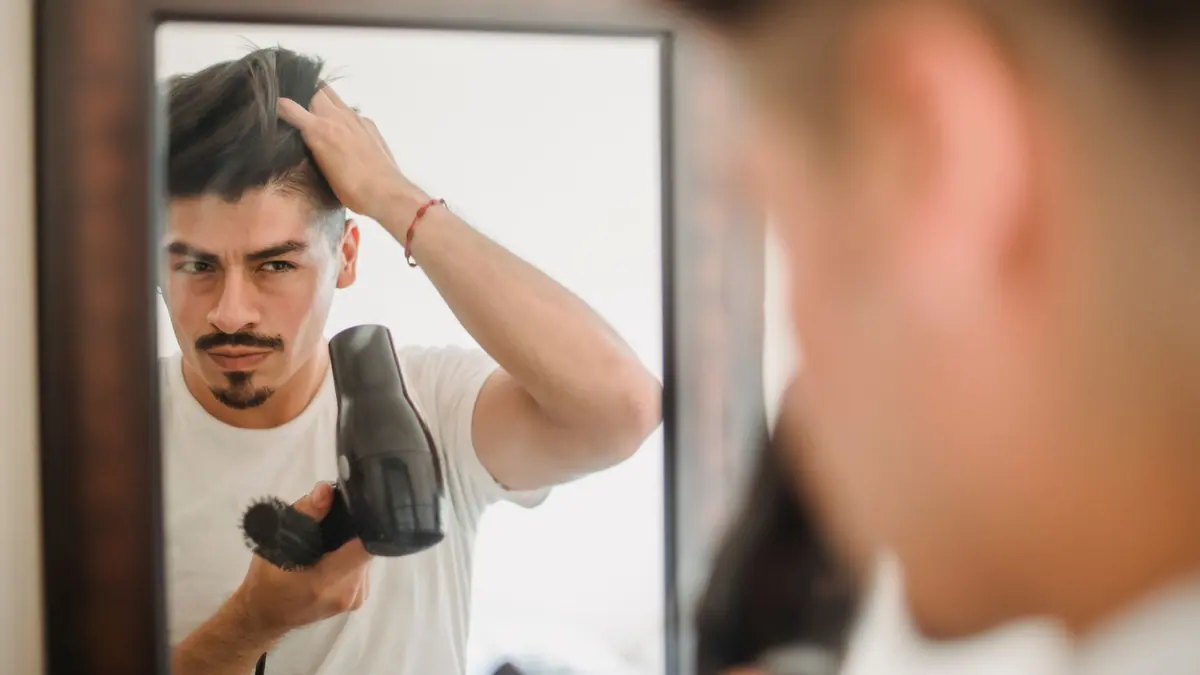
Most volume is won or lost in the first two minutes, while the hair is still damp. Rough-drying to around eighty per cent with the head tipped forward, before any brush is involved, does more for root lift than any amount of styling afterwards.
Then the cool shot. Hair holds whatever shape it is in when it cools, which is why finishing a section with cool air is the step that makes the difference between volume that lasts an hour and volume that lasts the day. Skipping it is the most common reason a blow-dry falls flat by noon.
Distance matters too. Holding a concentrator close raises the local temperature sharply and does not speed anything up meaningfully. Keeping a hand’s width between the nozzle and the hair costs almost no time and removes most of the heat exposure.
Who this isn’t for
Skip all of this if your hair is thick, coarse or very long. That hair genuinely benefits from more heat and more power, because the constraint is getting moisture out of a large mass rather than avoiding over-drying a small one. Buying a lightweight, airflow-led dryer for thick hair means standing there for a very long time.
It is also the wrong advice for curls, where diffusing at low speed and disturbing the hair as little as possible is the technique, and where a concentrator is actively unhelpful. And if your hair falls flat despite careful drying, the cause may be product build-up or something else entirely — that is a hairdresser’s question rather than an appliance one.
What to know before you buy
- Look for airflow, not wattage. Wattage is a power consumption figure.
- Insist on separate heat and speed controls. This is the single most useful feature for fine hair.
- Pick it up before buying if you can. Weight decides whether you finish the blow-dry properly.
- Check the nozzle attaches firmly and, ideally, rotates.
- Find the filter and confirm it comes off for cleaning.
- Use the cool shot every time. It costs thirty seconds and it is what makes the result last.
Do expensive hair dryers actually dry faster?
The good ones dry faster at a lower temperature, which is a different and better claim. Much of the premium goes on motor quality and weight, both of which matter for fine hair. Whether that is worth it depends entirely on how often you dry — daily users get the benefit repeatedly, occasional users do not.
Is air drying better for fine hair?
Gentler, certainly, but not automatically better for volume. Hair left to dry flat against the head sets flat. If you air dry, doing the first few minutes upside down, or clipping the roots up while damp, recovers most of the lift a blow-dry would have given.
Does a diffuser help fine hair?
Only if you have wave or curl to preserve. On straight fine hair a diffuser mostly slows the process down without adding anything. The concentrator, aimed along the hair rather than at it, is the attachment that earns its place — the same principle of buying for your actual case that runs through five questions before any large purchase.
The pattern is consistent with the rest of this category: the expensive thing is not automatically the right thing, and the technique is worth more than the upgrade. Buy a light dryer that moves a lot of air, use less heat than feels efficient, finish every section cold, and clean the filter twice a year. If you want the same argument applied to a whole routine, our guide to routines that survive a busy week makes it at greater length.