Every waterproof jacket is trying to do two things that oppose each other. It has to stop liquid water getting in, and it has to let water vapour from your body get out. The materials that do the first well tend to do the second badly, and the entire specification sheet of a technical jacket is an attempt to describe where a particular design lands on that spectrum.
Understanding this makes the category far less confusing. There is no jacket that is best. There is a jacket that is right for standing still in heavy rain and a different one that is right for walking uphill in drizzle, and buying the wrong one leaves you wet either way — just from different water.
Why you get wet inside a waterproof jacket
The most common complaint about expensive waterproof jackets is that the wearer ended up damp anyway. Usually the jacket did not leak. It simply could not move vapour out faster than the wearer produced it.
A person walking uphill generates a substantial amount of moisture. A membrane can only transfer vapour when there is a difference in humidity across it, and once the inside of the jacket is saturated that gradient collapses. At that point the best membrane in the world stops working, and the sensation is identical to a leak.
This is why ventilation features matter more than membrane specifications for anything active. Pit zips, a two-way front zip and cuffs that open let you dump heat and moisture directly rather than asking the fabric to do it.
Temperature works against you in the same way. Membranes transfer vapour best when the outside air is cold and dry, because that is when the humidity difference across the fabric is greatest. On a mild, damp day — the most common British walking weather — there is very little gradient to work with, and even a good jacket breathes poorly. That is not a defect; it is physics, and it explains why the jacket that felt superb in January feels sweaty in September.
The practical conclusion is to stop expecting the fabric to solve the problem and start managing it yourself. Set off slightly cold, open the jacket before you start sweating rather than after, and treat the zips as the primary temperature control. Most people over-dress at the trailhead and spend the next hour paying for it.
Wetting out, and the finish that fails first
The outer fabric of a waterproof jacket carries a water-repellent finish that makes rain bead and roll off. When that finish wears away, the face fabric absorbs water instead. The membrane underneath is still waterproof, so nothing leaks — but a saturated outer layer blocks vapour transfer completely, and the jacket stops breathing.
The result is a jacket that seems to have failed after a season or two. It has not; the finish has. Reproofing is inexpensive, takes an evening, and restores most of the performance. Washing with the right product rather than ordinary detergent also matters, because detergent residue attracts water and undermines the finish directly.
This single piece of maintenance is the difference between a jacket that lasts three years and one that lasts ten, and almost nobody is told about it at the point of sale.
The main constructions
| Construction | Strength | Weakness | Suits |
|---|---|---|---|
| Two-layer with liner | Affordable, comfortable next to skin | Heavier, bulkier to pack | Everyday and commuting use |
| Two-and-a-half layer | Light and packable | Clammy inside; the print wears | Carrying a jacket you hope not to use |
| Three-layer | Durable, breathable, no separate liner | Expensive, and stiffer | Sustained hard use in bad weather |
| Coated non-membrane | Cheap and genuinely waterproof | Barely breathes at all | Standing still, or short exposure |
Coated jackets are treated as the poor relation and should not be dismissed. If your use is walking the dog for twenty minutes or standing on a touchline, a coated jacket keeps you dry for a fraction of the price and the breathability limitation never comes into play. Buying a three-layer technical shell for that use is spending a great deal on a property you will not use.
Hoods and hems decide comfort
The details that determine whether a jacket is pleasant to wear are the same ones as on a coat, and they are frequently better executed on outdoor jackets because the requirement is more obvious.
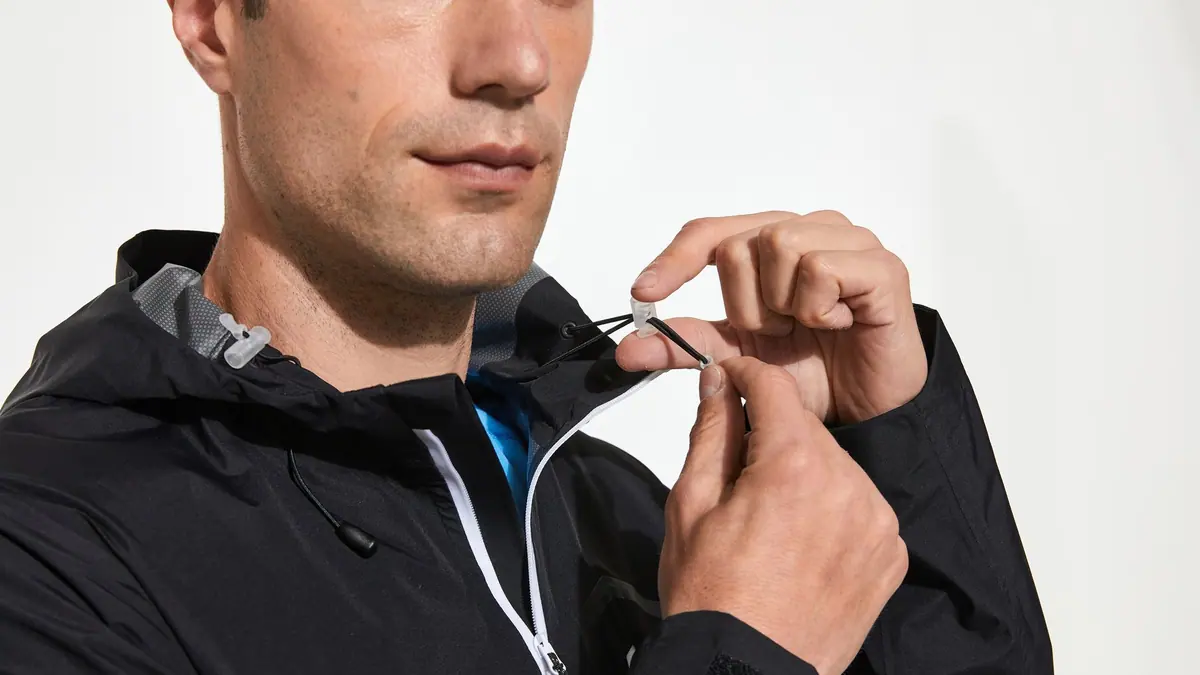
- A hood that turns with your head. Volume adjustment at the back is what makes this work.
- A stiffened peak. Without it, rain runs onto your face and down your neck.
- A high collar that closes above the chin without chafing.
- Pockets above a hip belt. If you carry a pack, low pockets are unusable.
- An adjustable hem to stop wind driving up inside.
- Taped seams throughout. Untaped seams make the waterproof rating irrelevant.
Check the hood with a hat on, and with the pack you actually carry. A hood that fits over bare hair and not over a beanie is a hood that fails on exactly the days you need it.
Cut is the last thing worth checking and the easiest to overlook in a shop. Raise both arms above your head: if the hem lifts to your ribs, the jacket will ride up every time you scramble or reach, letting weather in at exactly the wrong moment. A jacket with a longer back and articulated sleeves stays put, and the difference is obvious the first time you use it properly.
Who this isn’t for
Skip technical shells entirely if your outdoor time is short and low-effort. The breathability you are paying for only matters when you are working hard enough to sweat, and for a walk to the shops a cheap coated jacket is genuinely the better buy.
Skip them too if you run. Running generates more moisture than any membrane can move, and the honest answer for runners in rain is usually a light wind-resistant layer and accepting that you will get wet. A waterproof running jacket is a compromise that satisfies nobody in sustained rain — the kit that matters for runners is covered in our piece on choosing running shoes.
What to know before you buy
- Decide whether you will be working hard. That single question picks the construction.
- Prioritise ventilation over membrane names for anything active.
- Check the seams are taped, all of them, not just the main ones.
- Try the hood with a hat and a pack. This is where jackets fail in use.
- Buy reproofing wash at the same time. You will need it within two seasons.
- Never use ordinary detergent. Residue destroys the repellent finish.
What do waterproof ratings actually mean?
They describe how much water pressure a fabric resists in a laboratory test, which correlates loosely with real-world performance. Above a certain point the number stops being the limiting factor and construction takes over — a highly rated fabric with untaped seams is not a waterproof jacket.
Why does my jacket leak at the shoulders?
Usually because a rucksack has abraded the repellent finish and compressed the fabric against you, which is the classic wetting-out pattern rather than a leak. Reproofing normally fixes it. If it persists, check the seam tape under the shoulder for lifting.
Is an expensive jacket worth it?
If you are outdoors in bad weather regularly and working hard, yes — three-layer construction and good ventilation are genuinely better and last longer. If you are not, a mid-priced jacket maintained properly will outperform an expensive one that has never been reproofed. The same reasoning appears in choosing a coat for a walking commute and in buy it for life versus replace it twice.
The way to choose is to be honest about your output. Standing still or strolling: buy cheap, buy waterproof, ignore breathability. Walking uphill with a pack: buy ventilation first, membrane second, and budget for reproofing. Running: accept that you will be wet and buy something light instead. Once the activity is stated, the confusing part of this category disappears.